Experimentation as a Service
Public sector innovation
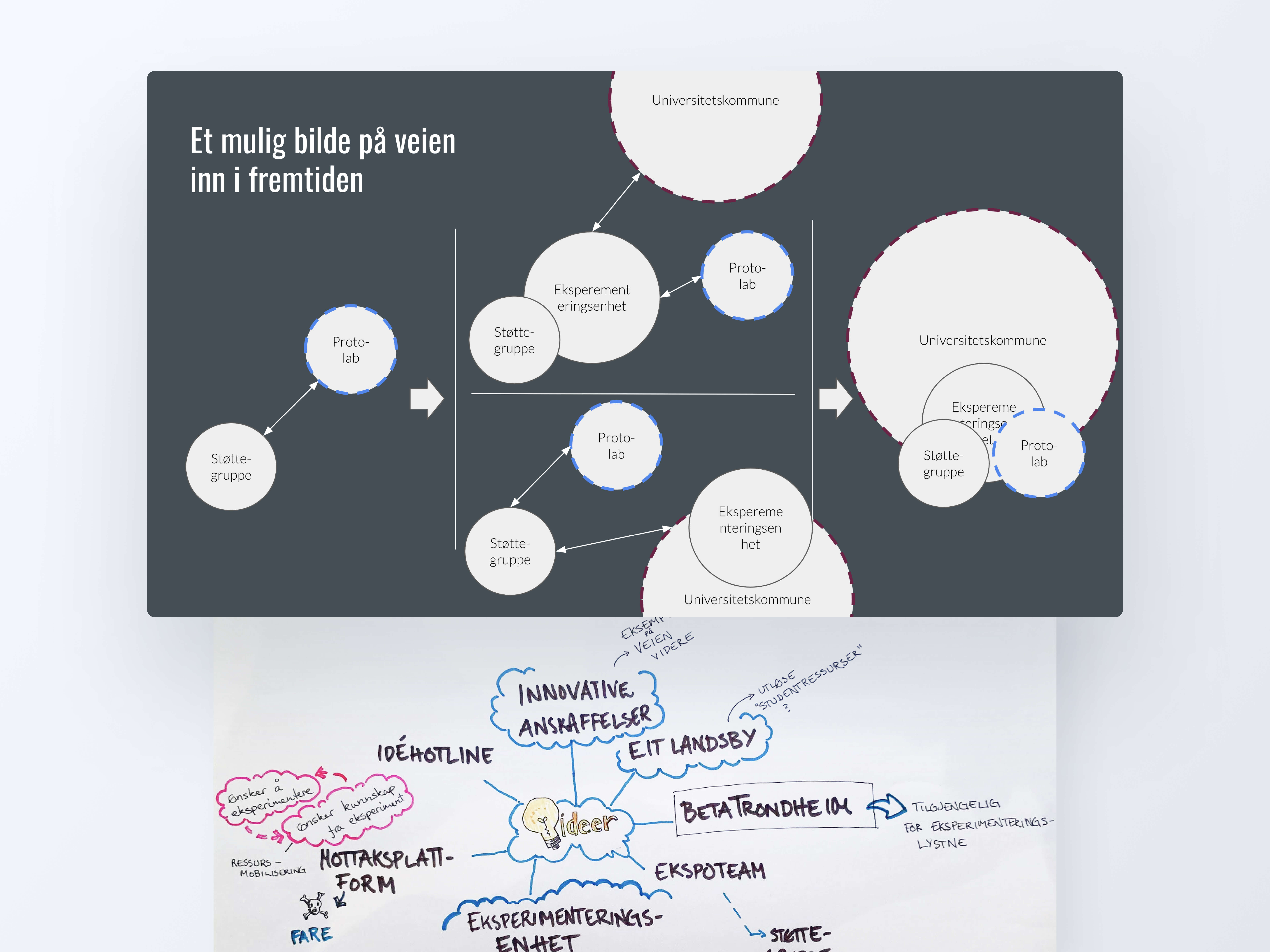
How can the staff and support functions in Norwegian municipalities provide support for experimentation?
Today, staff and support functions sustain all daily operations within the municipality. Some examples of these daily operations include nursing homes, kindergartens, lower-level education, and city planning. To an extent, they are similar to those typically found in business, such as IT, finance, personnel, and communications. However, services such as archives, city council secretariat, and interpreting services are also needed in a municipality.
Team and role

For this project, I was part of a design team of two, representing the design agency Spring Methods. We were hired as innovation experts and service designers to assist in the project titled "Experimentation as a Service." The project was funded by the county governor in Trøndelag, and owned by the entities known as the “internal services” in Trondheim and Steinkjer municipality. We worked mainly together with a project group from Trondheim municipality.
Problem
Societal developments can occur at a pace that requires quick transitions. Today's internal service does not support such changes or transitions, or even ideas for improvement by the municipal staff. They support operations as is, in a rapidly changing society this is becoming a challenge.
This is why the municipality aimed to establish a support system that can guide innovative initiatives from within the organization, as well as daily operations.
Goal
The goal of the project was to understand how a municipality can better support experimentation and then lay the foundations within the internal services to implement the findings of the project.
Research and discovery

Through the Experimentation as a Service project, we focused our efforts on employee-driven innovation. Together with the project group from the municipality, we guided the project through the design process. User interviews, observations, and project workshops were conducted, and user journeys were made.
We also prototyped a small first version of a municipal "Experiment as a Service" unit. The findings made during these activities were used to design a service blueprint.
The project group consisted of a number of managers and employees from the different internal services within Trondheim municipality, shown in the stakeholder map above. In the middle is the intrapreneur/idea owner.


Outcome

Prioritization and support are not the same thing. For instance, the University of Agder makes a clear separation between deciding where to allocate funds and providing expertise for support. The same goes for organizations like Innovation Norway - the departments that decide where to give funds are different from the ones that offer advice and training.
This blueprint is now used in the continued efforts within the municipalities to ensure the implementation of internal experimentation support. The project secured funding to continue further into 2020 and launch "Experimentation as a Service 2," led by one of the members of our project group in Trondheim.
Reflections
As much as the workshops and design activities helped us achieve our outcome, it became clear that the people we were working with were just as much key to success. After the project concluded, it was the program manager and strategic advisor of the "Digital as first choice" program, that was in a position to take it further to "Experimentation as a Service 2."